44%
Breaches with ransomware
Ransomware was present in 44% of breaches analysed, and in 88% of breaches at small and mid-sized organizations.

Ransomware doesn't need a genius. It needs an unpatched VPN box, an aging server or a shared password. We design, build and run the systems an enterprise depends on, from internal business systems and remote access to e-commerce and customer platforms, with as little exposed as possible, then keep them updated and watched.
Ransomware was present in 44% of breaches analysed, and in 88% of breaches at small and mid-sized organizations.
Edge devices and VPNs were the target in 22% of vulnerability exploitation, up from 3% a year earlier.
Only about half of known edge-device vulnerabilities were fully patched during the year, with a median of 32 days to do it.
Source: Verizon 2025 Data Breach Investigations Report, an analysis of 22,052 security incidents including 12,195 confirmed breaches.
Remote access appliances sit on the open internet. When a patch lands late, they become the front door.
Every theme and plugin is someone else's code with its own update cycle, and an admin login anyone can find.
Systems past vendor support stop getting fixes, but stay connected to everything else.
One reused or phished password opens everything that account can reach.
Ransomware encrypts the backups too, so recovery takes weeks instead of hours.
Third parties were involved in 30% of breaches, double the year before (Verizon, 2025).
Operations systems, portals, command centers and data flows connected to the systems you already run, with access set by role.
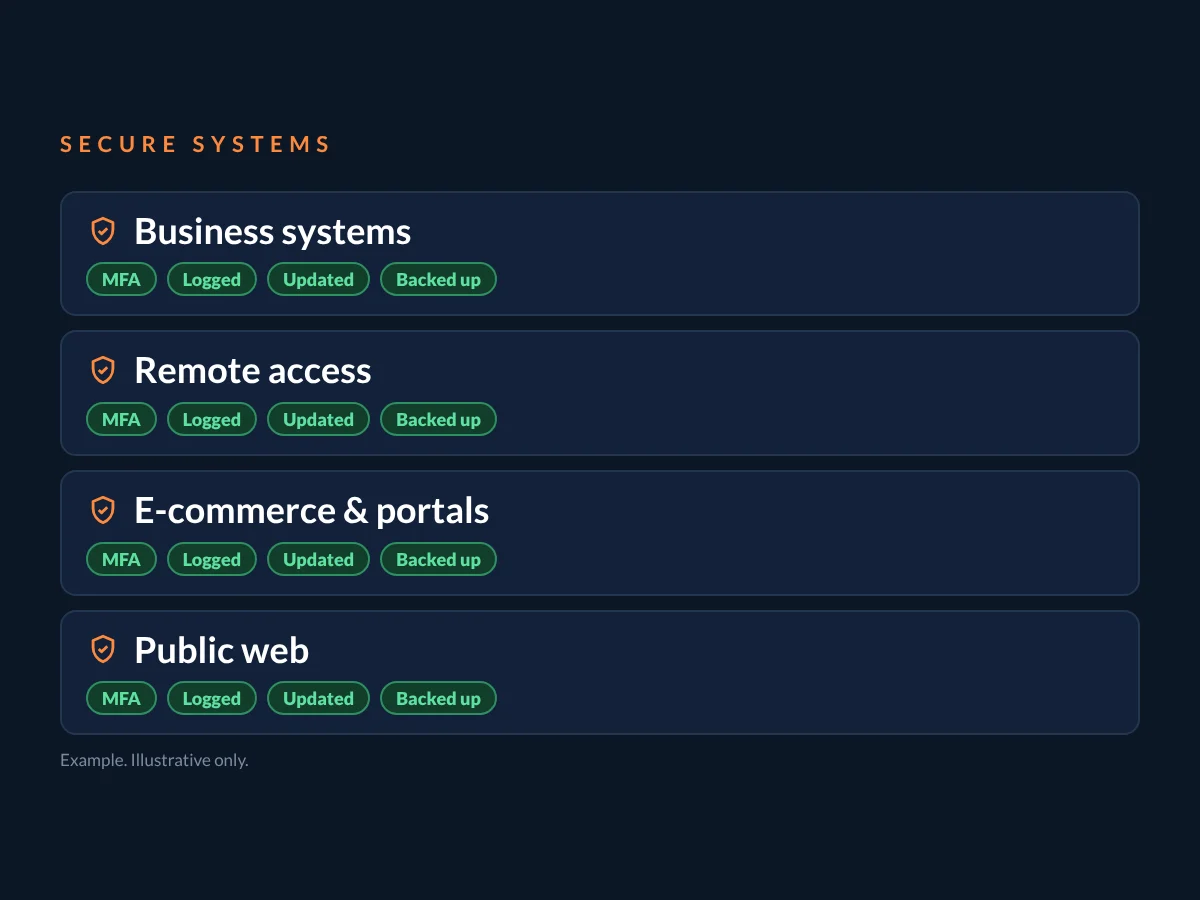
Systems integrationStaff and partners reach internal systems through single sign-on and multi-factor sign-in, instead of a VPN appliance on the open internet.
Online stores, customer and partner portals on modern managed infrastructure, with payments handled by the payment provider so card numbers never touch your servers.
Corporate and multilingual sites with no plugins, no public database and no admin login on the open internet.
Secure web presenceAdmin screens, databases and internal tools stay off the open internet.
Single sign-on and a second factor for every staff and admin account.
People reach only what their job needs, so one stolen login opens less.
Sign-ins, changes and admin actions recorded, so anything unusual can be traced.
Copies kept separate from the live systems and tested, so recovery is measured in hours.
Patches, renewals and monitoring are part of the retainer. Nothing waits for the next project.
Japan's new supply-chain security rating (SCS, ★3 and ★4) is due to start around March 2027, and customers will ask suppliers which level they meet. Our free 26-item ★3 self-check takes about five minutes, shows results on the spot and never leaves the browser.
What you run today, what worries you most and which rules or customers you answer to.
Every system, login and connection that can be reached from outside, and what each one can reach inside.
New or replacement systems built to the standard above, moved over without stopping the business.
Updates, monitoring and backups handled by us. Daily updates are logged and a weekly summary goes out by email.
Design, build, implementation, operation and new work sit under one monthly retainer. Terms auto-renew every 90 days unless cancelled 30 days before the renewal date. Enterprise engagements typically run $50,000 to $100,000+ a month.
No one honestly can. What we can do is remove the entry points attackers rely on, harden what has to stay reachable, log everything and keep backups that let you recover fast.
No. We start with whatever is most exposed, usually remote access or internet-facing systems, and move the rest over in order of risk without stopping the business.
Yes. We build and run online stores on modern managed infrastructure, with payments handled by the payment provider.
Yes. Internal systems can be reached through single sign-on and multi-factor sign-in instead of a VPN appliance on the open internet.
We do. Updates, monitoring and backups are part of the monthly retainer, and the documentation lives in your own systems.
Work runs on a monthly retainer. Terms auto-renew every 90 days unless cancelled 30 days before the renewal date. Enterprise engagements typically run $50,000 to $100,000+ a month.