49%
Using AI nobody approved
49% of workers admit using AI tools without employer approval, and 33% have shared company research or data sets with them.
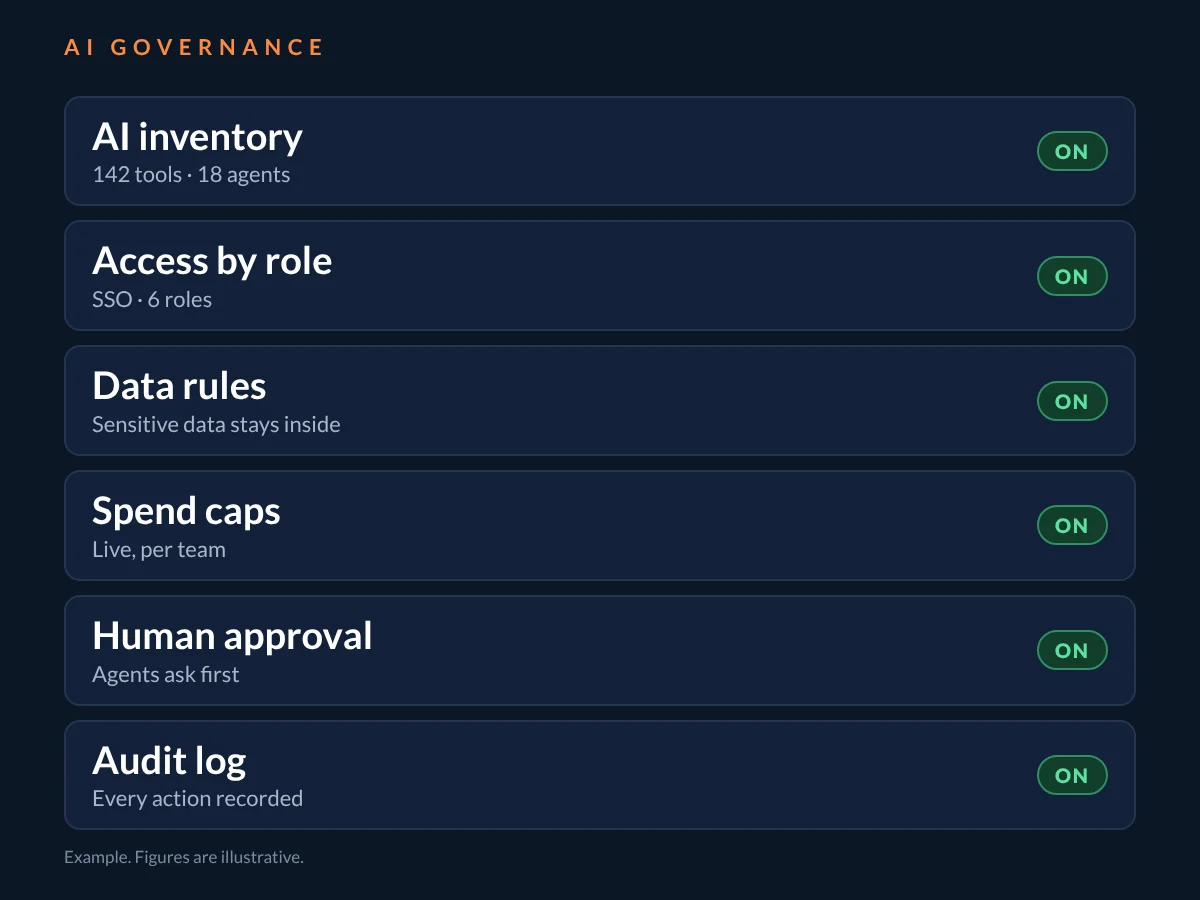
Staff use AI tools nobody approved. Agents act without a clear owner. Nobody can show the board what AI costs, or what data it touched. We put every model, tool and agent under one set of rules: who can use what, with which data, at what cost, with every action logged.
49% of workers admit using AI tools without employer approval, and 33% have shared company research or data sets with them.
77% of CIOs and CTOs say AI adoption is outpacing their governance (IBM, 2026).
85% of IT teams say every AI agent has a named owner, but only 42% say that ownership is actually clear.
Sources: BlackFog survey of 2,000 workers at companies with 500+ employees, reported by CIO (Jan 2026); IBM Institute for Business Value, CIO and CTO study (June 2026); Ivanti, Scaling AI in IT Operations 2026, survey of 1,500 IT professionals (fieldwork Feb to Mar 2026).
Staff paste contracts, customer records and financials into public chatbots because it saves them hours. Banning it doesn't stop it.
AI agents read email, update records and send messages. When one goes wrong, no one can say who approved it or what it touched.
AI costs sit across dozens of subscriptions, API keys and cloud bills. Finance finds out at the end of the month.
Every prompt to an outside AI service sends company data to servers you do not control, under terms you did not negotiate.
68% of IT professionals have seen AI hallucinate with operational impact, and 16% of those errors were not caught before damage (Ivanti, 2026).
The EU AI Act applies generally from 2 August 2026, and high-risk obligations now start 2 December 2027. Customers and auditors already ask for evidence.
Every AI tool, model, API key and agent in use, who owns it and what data it can reach.
A private AI as good as the public tools, behind your single sign-on, so staff stop needing the others.
Who can use which model, tool and data set, set by role and department.
What can and cannot go into AI, with sensitive fields kept on servers you control.
Budgets and hard limits per team, user and agent, with live cost on one dashboard.
Agents ask a named person before they send, pay, delete or change anything that matters.
Every prompt, answer, agent action and approval recorded, for audits and investigations.
Usage, cost, incidents and policy exceptions in one view for leadership and the board.
We map your controls to the frameworks your customers, regulators and auditors ask about, and keep the evidence current. We don't issue certifications; we put the controls and the evidence in place.
The US AI Risk Management Framework: govern, map, measure, manage.
The international standard for an AI management system.
Generally applicable from 2 August 2026; high-risk obligations from 2 December 2027.
Health and student records stay on servers you control, with access logged.
Where AI is used today, what worries you most and which rules apply to you.
Tools, models, keys and agents, who owns each one, what data it reaches and what it costs.
Access, data rules, spend caps, approvals and the audit log, connected to the systems you already run.
New tools, new agents and new rules are brought under control as they appear.
The same safeguards come standard in every system we build.
Our secure private cloud, your own cloud account or your own servers. Private AI scales up instantly with demand.
With private AI, prompts, documents and answers never go to an outside AI company.
People see only what their role allows, and AI never answers from documents they can't open.
Who did what, and when, including every AI and agent action, recorded in an audit log.
Every AI and agent has a hard budget. It stops and reports before it goes over.
Documented handover. The system is yours.
Design, build, implementation, operation and new work sit under one monthly retainer. Terms auto-renew every 90 days unless cancelled 30 days before the renewal date. Enterprise engagements typically run $50,000 to $100,000+ a month.
The rules and controls that decide who can use which AI, with which data, at what cost, and how every action is recorded and reviewed. It covers chat tools, AI built into the software you buy, and AI agents.
Bans rarely work. We give staff an approved AI that is as good as the public tools, find what else is in use, and set rules for what data can go where.
Every agent gets a named owner, access limited by role, spend caps and human approval for actions that matter, and every action goes into the audit log.
Yes. We map your controls to the frameworks you need and keep the evidence current. We do not issue certifications.
No. Governance covers the AI you already use. Many companies also add a private AI so sensitive data never leaves their servers.
Work runs on a monthly retainer. Terms auto-renew every 90 days unless cancelled 30 days before the renewal date. Enterprise engagements typically run $50,000 to $100,000+ a month.